Kawasaki Z e-1 charging upgrades: let's role-play The Martian
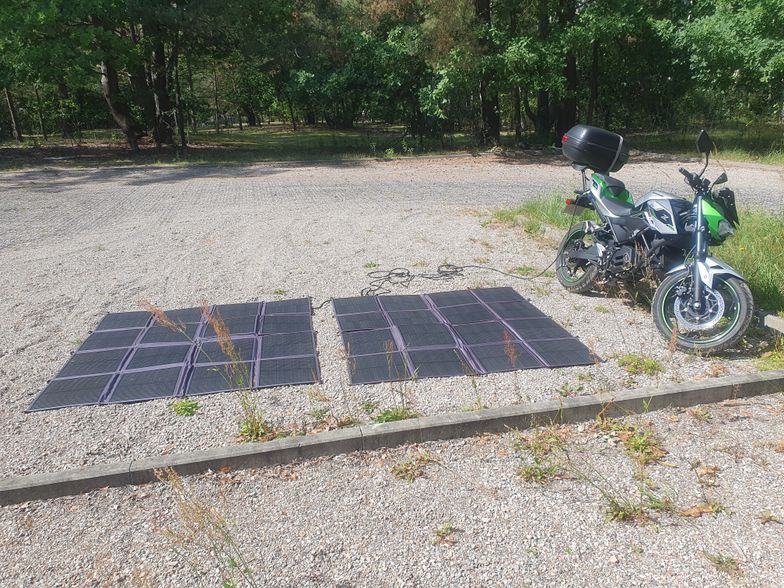
So I dared to go further than any Kawasaki Z e-1 owner was supposed to go. And I succeeded. With some caveats.
I enjoyed The Martian (imdb.com) movie quite a lot. There is a part where Mark Whatney travels the planet by subsequently charging the rover with solar panels. This project brings you as close to this experience as feasible... on planet Earth.
(still need to work on the "I have doubled my battery life by scavenging Rover 1" part though)
The build
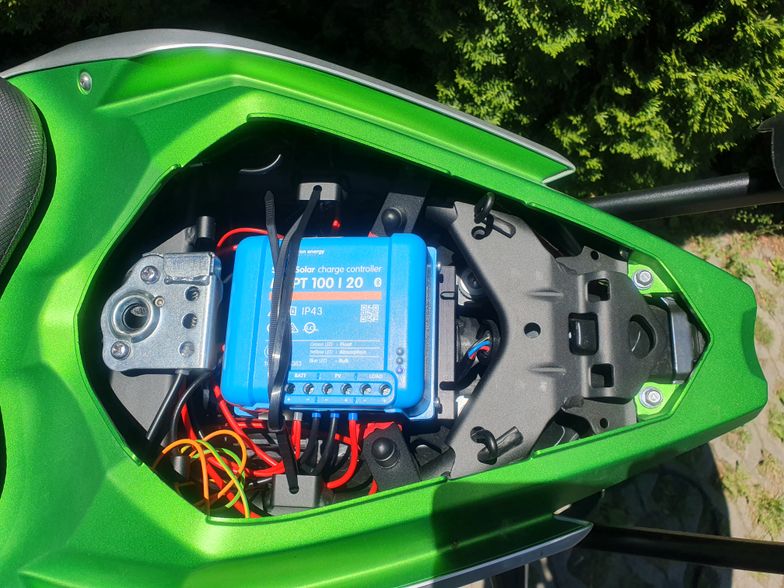
The recipe is quite simple. Apart from two (2) 400W N-Type Portable Solar Panel Blankets (renogy.com) you need the Victron SmartSolar MPPT 100/20 charger (victronenergy.com). The Victron is an excellent fit for the small Kawasaki as it is both small and 48V-capable. The bike was probably designed with it in mind. ;)
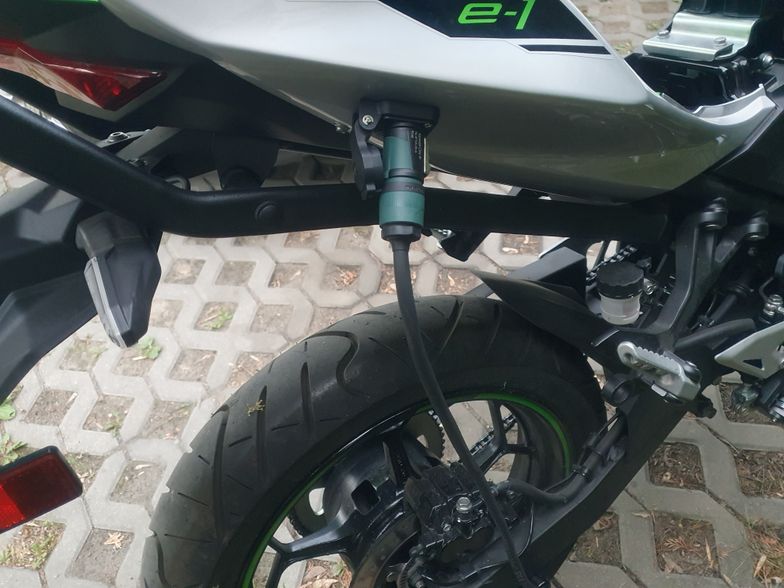
A charging port will make for a seamless experience. I used my favorite speakON (neutrik.com) socket and plug (4-pin variants) with additional spring-loaded waterproofing cap from the powerCON series: NSSC-1 (neutrik.com).
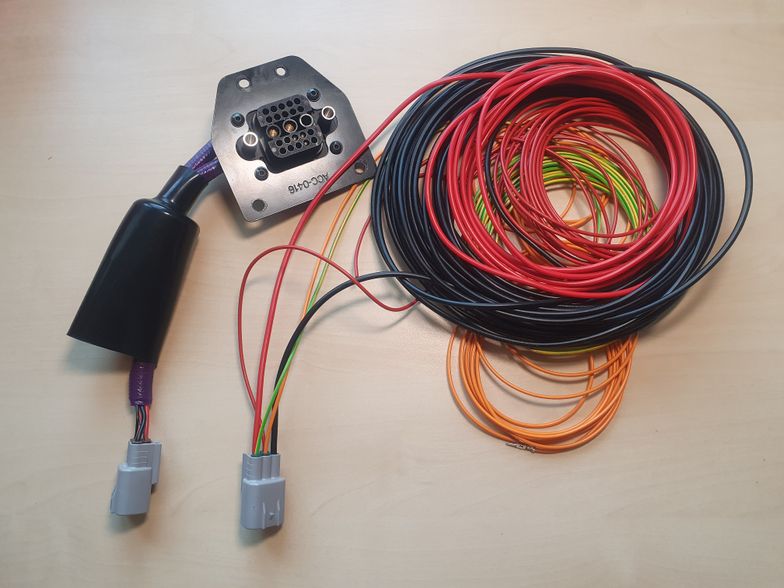
The rear charging port that I removed to place the charger is connected using a Sumitomo 090 5-pin connector (corsa-technic.com). Vehicle side is female 6189-0504, the adapter uses male 6188-0327 and that's what you need if you want to do a clean install without any wire chopping.
The two power wires are distinctly thicker and fused 15A at the bike, I used 2.5mm2 (14 AWG). There is an additional wire that needs to be connected to positive for the charging to work, activates the battery pass transistors (mine is thin red).
The off-board charger also shorts the other two pins - this lights up the "charging" indicator on the dash and as far as I remember also disables the DC-DC switcher for 12V battery charge (it's obvious when it is operating due to the audible noise it produces). Probably also prevents the bike from running. I have them available (green and orange) but didn't connect to anything.
I used 0.5mm2 (20AWG) for the control wires, that's probably an overkill.
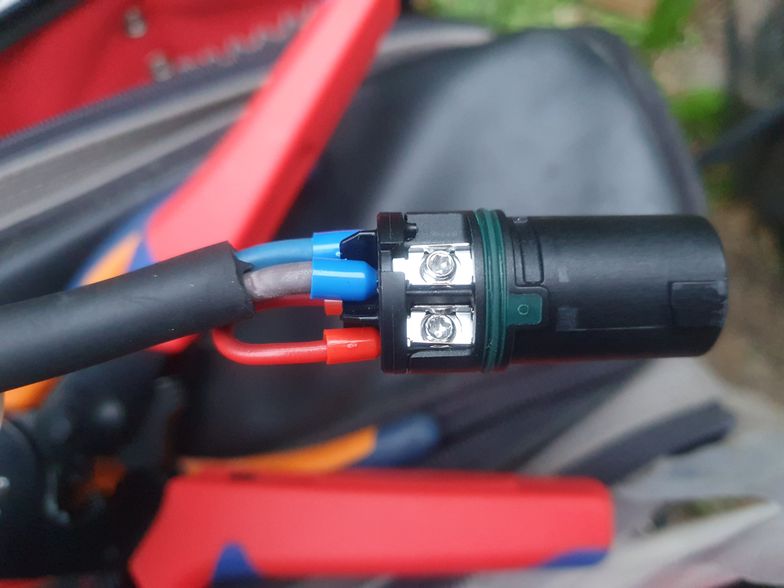
The one to be connected to hot/power is important. I am activating it using the other two spare pins on my charging connector by means of a direct short bridge. This design is good, keeps the charger unpowered when the charging cable is disconnected - the batteries are not being drained by my additions.
Turning on the bike also turns on the charger. You can use the Victron Bluetooth app to get the details of the last charging cycle without the charging cable connected.
Operation
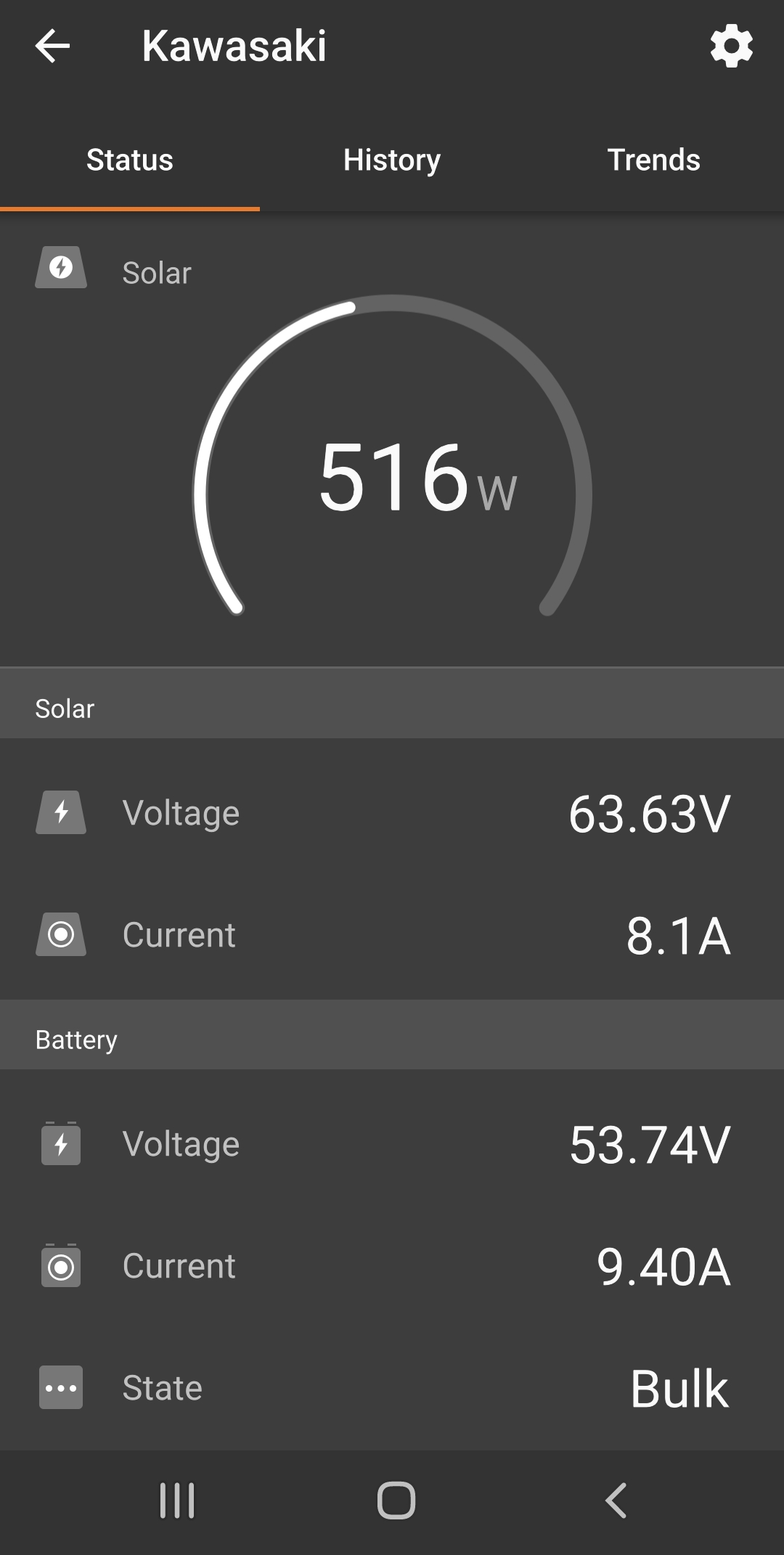
Those two panels in series give enough voltage to charge the 48V-system batteries directly (Victron needs 5V over battery voltage to start, 1V above to continue as per specs).
I was able to get around 500W sometime in late August (irradiance of about 800W/m^2). The Renogy blankets seem to be more like 300W-ish.
This is still on par with the off-board charger supplied with the bike, not bad and obviously safe to charge at this pace!
Riding the bike slowly at speeds for which it was intended, not exceeding about 50-60km/h, results in travel efficiency of somewhere around 20km/kWh. That results in 10km for every hour of charging, slightly better than what Mark had to work with (13 hours of charge for each ~100km). We need to charge twice a day (not enough battery capacity) but on the positive side we get to ride more than twice as fast (25km/h for The Martian).
At about 88% state of charge the constant voltage top charging phase begins and the charging speed gradually falls.
How to carry the panels
The two 400W solar blankets could be mounted as motorcycle side bags on something like the Givi TE4127 rack (PDF hosted on fortnine.ca). Unfortunately, this side rack intended for Ninja 400 seems to be unobtanium as of 2026.
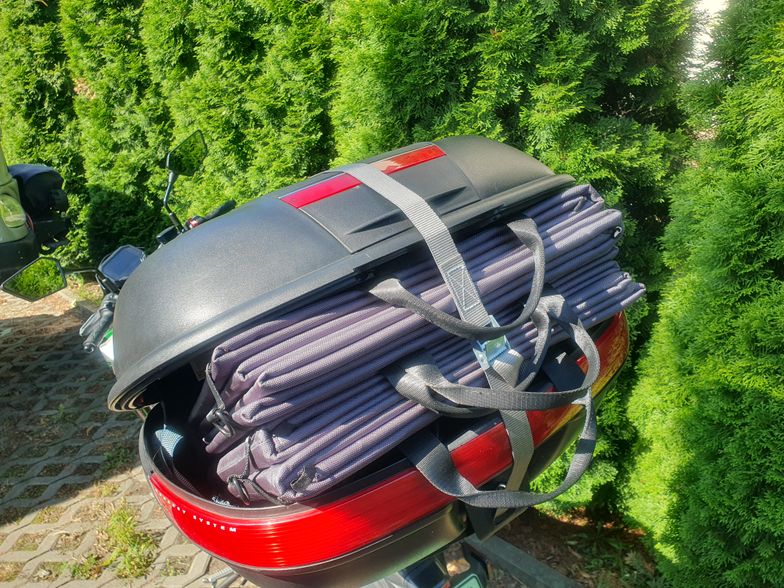
For my first trip I used my daily Givi E460 top case.
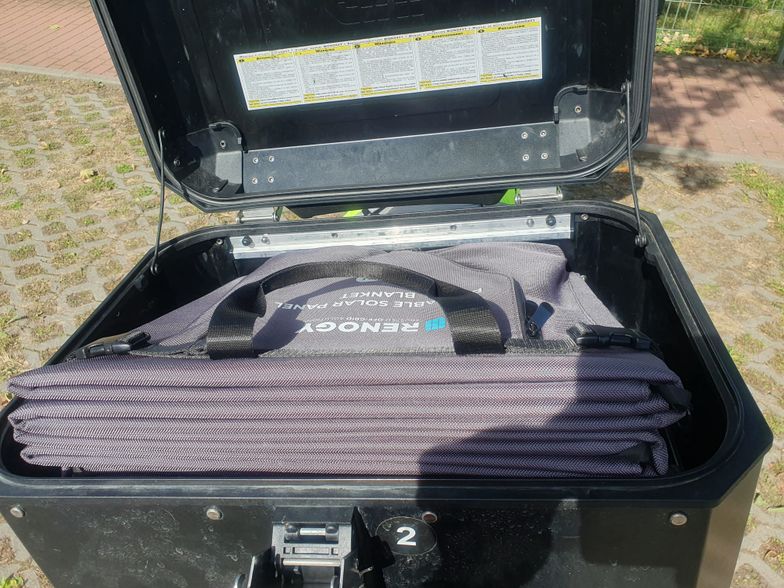
Later I discovered that the typical 58 liter aluminum travel case (Givi Trekker Outback 58, Kappa K'Voyager 58 or similar) will fit the panels with some room to spare (although at an angle).
How I actually charge the bike
I am slowly sourcing power from my overlander.
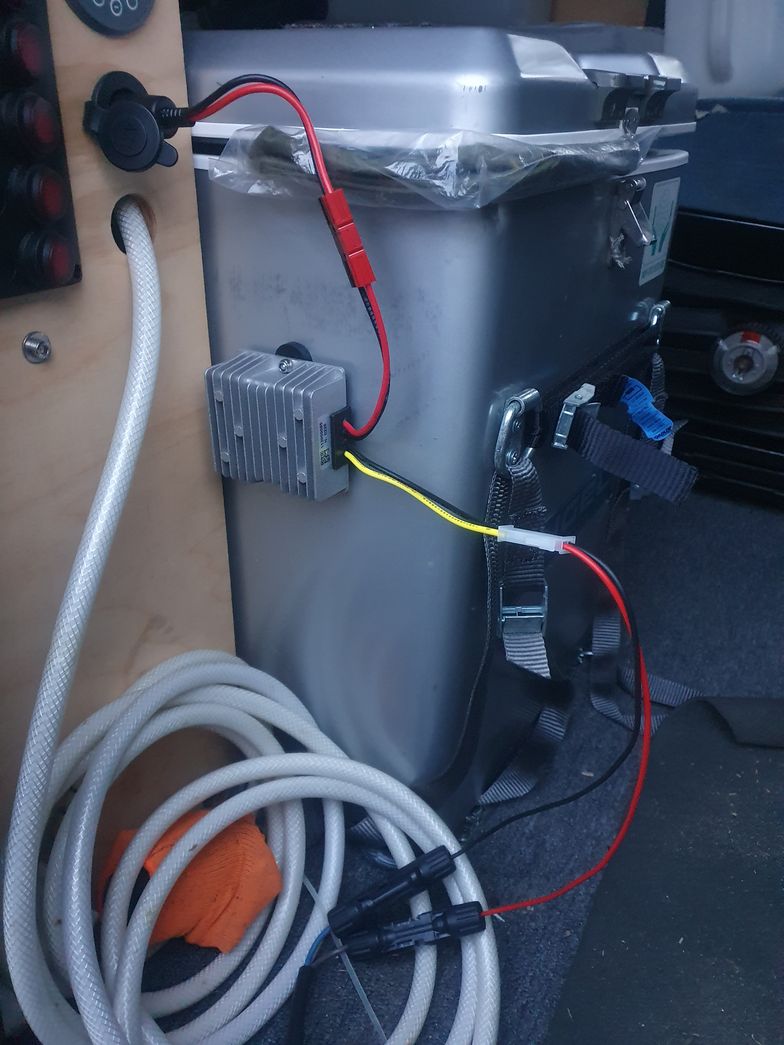
It's system is 12V nominal with ~5kWh of battery capacity supported by 350W of solar panels on the roof. I up-convert my battery voltage by using a cheap China-sourced 3A DC-DC resulting in a charging speed of about 150W (need to set a 3A charge limit at the Victron). That keeps the bike top-charged at all times and at the same time the system is able to keep up shall I start charging in the evening with the on-board batteries somewhat less than full.
This "plug in for charge in the evening" adds to charge cycles of my overlander batteries that I don't like. It could be remedied by turning the Kawasaki's charger on intelligently at sunrise and to operate at currents not exceeding solar yield using the Victron's Bluetooth capabilities.
Beware: buy a 72V DC-DC converter, the 65V I got seems not to have enough voltage headroom for the Victron to ramp-up reliably in all conditions. When the e-1's battery is close to full (above ~85% I think, close to constant voltage charge range) it will charge but at a reduced speed of 0.4A or something. Initiating the charge when the batteries are decently discharged goes well until the very end without issues.
Also take notice, that the cigarette lighther connection draw is 10A+. You do need sockets, plugs, cables, fuses and connections that are capable of doing this. Mine is designed and tested for 20A.
Current charger settings:
- absorption voltage: 57.70V (~4.12V/cell)
- float voltage: 57.40V (~4.10V/cell)
- absorption time: 1d (no limit)
- tail current: 0.5A.
It is worth noting, that my Victron MPPT is somewhat off in terms of what the actual voltages are. Last time I measured float it was 57.49V indicated (requested 57.40V, as above) but the actual value measured 57.2V. So, the actual voltages are lower than what the settings would suggest. I expect temperature also adds to the error (warm MPPT did some overshoot, then cooled down - but still below the actual figures).
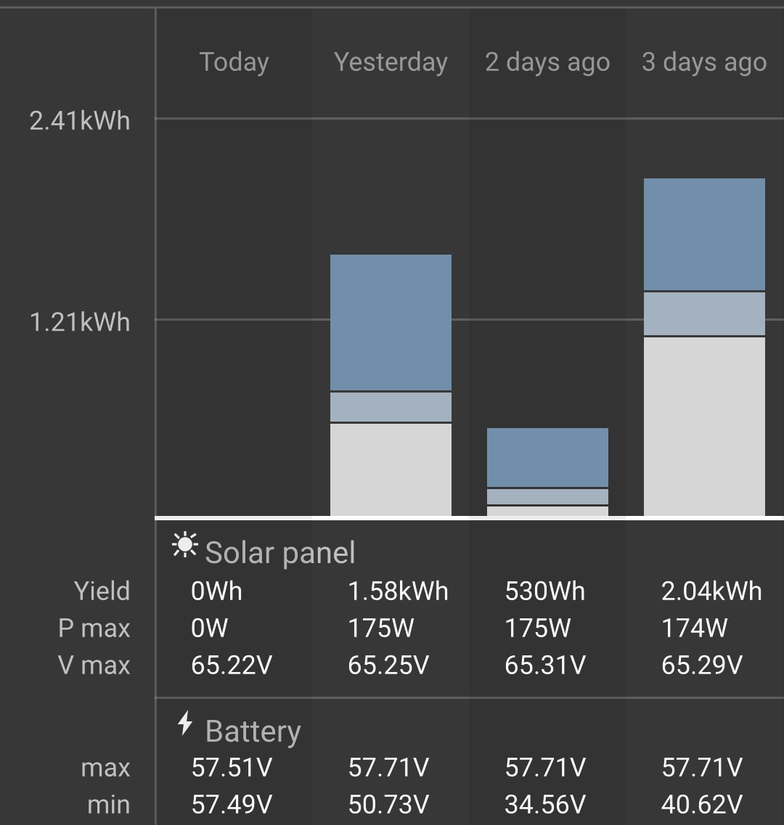
This probably is not ideal as lots of charging happens in float at somewhat elevated voltage with currents below 0.5A. But it was otherwise hard to make the batteries charge to 100%. Maybe I should decrease all voltages while also decreasing the tail current. I do remove the charger within at most a few hours after full so this should not have a detrimental effect on the batteries.
The batteries are slow to top charge and the top charge is needed to have decent amount of good full-speed range. The total useful capacity of the packs seems to be only about 2kWh (!). The bike is slowing down below "initial turtle speed" at about 25% SOC indicated on packs (last bar on dash).
DC/DC converter notes
The 65V step-up DC-DC I procured is actually quite decent. The wide input voltage range of 12-30V allows it to also be used in a 24V system.
Some performance figures:
- idle current: 50mA @13V, 10mA @26V
- at 13V about 92% efficient (0.5A+ loads)
- at 26V about 94% efficient (1.0A+ loads).
Runs quite hot, as expected.
Other converter considered (more power, expensive): Orion-Tr DC-DC Converter: 12/48-8 or 24/48-8,5 (victronenergy.com).
More charging speed?
The small Victron MPPT at ~1000W is twice as powerful as the off-board charger and will be adequate for 4x 400W solar blankets in a serial-parallel configuration doubling the charging speed.
You could also build a nice Kawasaki stationary charging solar roof with something like 2 cheap standard large solar panels. You need to keep the maximum system voltage below 100V so, probably connected in parallel.
Don't know how the batteries would cope with 20A of charge, they should be fine when charged as a pair. The off-board charger outputs 10A when charging them one by one.
The 15A fuse at the bike would obviously need to be replaced with a larger one. Would need to look at the cabling whether it is thick enough. Top charging would still be slow.
Fewer panels to carry?
If you would like to use a single smaller/cheaper panel with lower voltage (up to 60 cells in series) a 36V/48V Rover Boost 10A MPPT Solar Charge Controller (renogy.com) might be the solution. But the maximum open circuit voltage of the panel(s) can't exceed 40V! One 400W or two 200W Renogy solar blankets in series should work. You need to find a good spot to install the charger on the bike.