Small offgrid solar power plant
I originaly designed and made this setup to power a Gen2 Starlink.
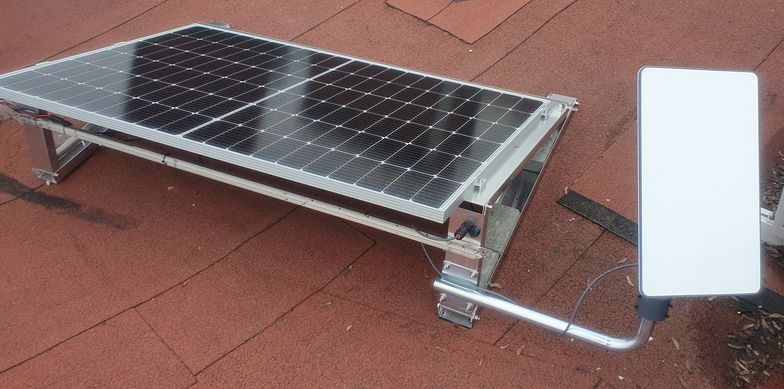
One of the initial electrical setups looked like this:
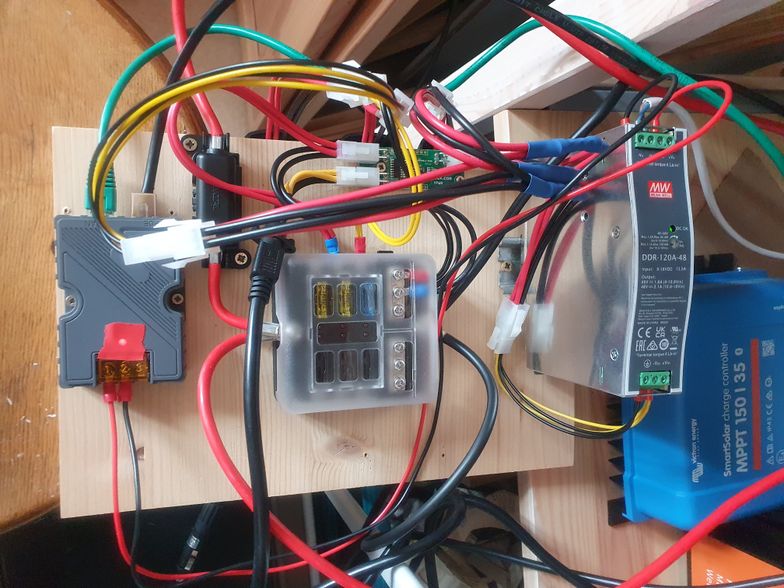
The build
- PV panel: JA Solar JAM60S20-385/MR (385W)
- charger: Victron SmartSolar MPPT 150/35
- battery: LiTime 200Ah Plus (200A max charge/discharge)
- fuse for the charger: MIDIVAL, 40A (holder: MTA 0300360)
- wiring: 10mm2 wire between charger-fusebox-battery (copper)
- PV panel wiring: 6mm2 black/red solar wire (10m length each), MC4 connectors
- 12/48V DC/DC converter: Mean Well DDR-120A-48 (2.1A/100W rated, 3.15A peak)
- power redundancy: Y-PWR
- AC/DC backup power supply: 12V, 16A 192W Adapter Technology ATS200T-P120 (www.bicker.de), also known as STD-12160 (MiniPC.de) - beware, these have different pinouts than Mean Well -R7B!!!
- fusebox for 6x ATO/ATC fuses
- cigarette lighter sockets: SCI A13-142A (these are excellent, will do up to 20A with A13-147 matching plugs)
Performance
Solar power is not a year-round pleasure. At my place of installation, it only makes sense between March and October - 8 months out of 12. Your milage may vary.

Especially between November and January the results are quite abysmal.

I managed to produce almost 330kWh during this year. For the period between March and October the production was almost exatly 50W on average. Theoretical yearly production for a 385W panel is about 385kWh per year for my place of installation.
The result could have been better - I just didn't manage to consume the energy fast enough. In early July I removed the 12/24V DC/DC switcher because I needed it for Starlink operation in my offroader. I re-connected the PoE switch back to the wall socket and thus lost some of the loads. After some afterthought I added some other stuff but "it didn't compensate for the loss". ;-)
Battery sizing for optimal yield
I would consider my battery size well-matched for the power output and the load. 200Ah is a capacity that can supply 50W for about 48 hours (51.2h with 2.56kWh per specs). It keeps everything powered overnight and also gives enough room for a few cloudy days.
Automatic fail-over to AC backup power
Solar power performance is unpredictible so you probably need a supplementary backup power source.
I went the easy route by using an off-the-shelf power load sharing controller: Y-PWR (MiniPC.de). Power redundancy can be achieved by simply connecting the battery and a 12V power supply together. Solar power gets consumed first.
This happens to work without any additional circuitry because typical LiFePO4 battery voltage is higher than 12V (in my case up to 14.2V when being charged). When the voltage falls down to 12V the battery is almost empty. The AC/DC power supply current will only start to flow below that value thus giving prioriority to the battery.
Environmental impact
My recent electricity bill showed na annual consumption of almost 1500kWh. All of the power I got from my solar farm would have been needed anyway, so that would add about 330kWh to the bill. That's 22% more, which means I managed to save about 18%.
I would consider this a meaningful positive impact. I could do even better with more panels. :P With 8 out of 12 months being useful, that would roughly account for 1200kWh. Up to 3 panels in total seem to make sense.
Improvement notes
Need to move all the stuff into some electrical enclosure.
Having everything mounted on wood (flammable material!) is a not good terrible idea.
This has been in prototype for far too long.
The Y-PWR needs a better replacement (less losses, more headroom).
For the next season I would also like to be able to directly power my laptop/dock/monitor.
Might think of doubling the performance by adding an additional panel (beyond charger capabilities), increase system voltage to 24V (need another battery, different 24/48V DC-DC but the charger could just stay). In order that to make sense I would need to be capable of consuming more.